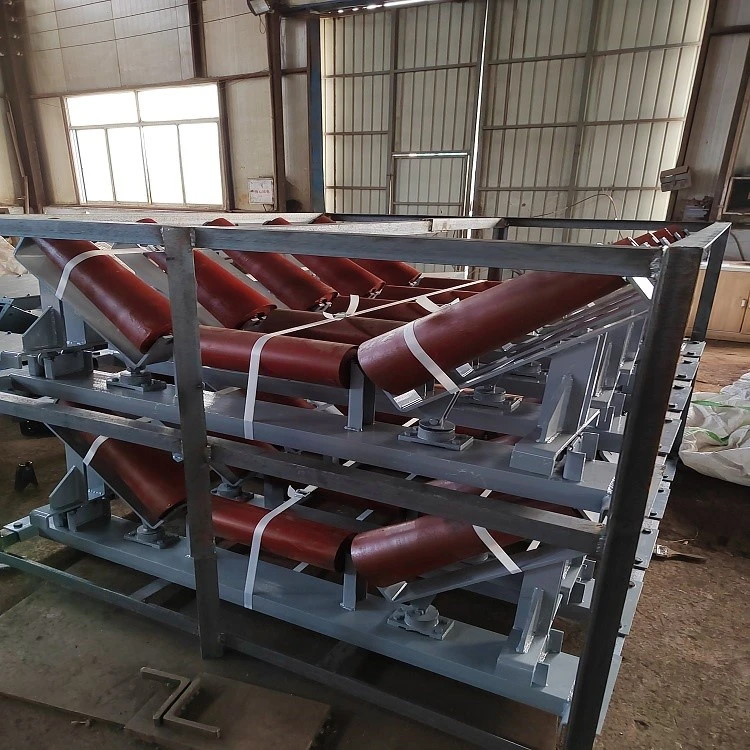
As an important component in the conveying system, rubber rollers are widely used in industrial fields such as mines, ports, and power plants. The quality of their installation directly affects the running stability, energy consumption, and service life of the conveyor belt. This article will introduce the correct installation method of rubber rollers in detail to help users optimize the performance of the conveying system.
Preparation before installation
Before installing rubber rollers, make sure that the conveyor belt is properly tensioned and clean up the debris in the installation area. Check whether the roller surface is smooth and undamaged, and whether the bearing rotates flexibly. If cracks or deformations are found in the rollers, they should be replaced in time to avoid affecting the normal operation of the conveying system.
Detailed explanation of installation steps
Determine the installation location
According to the width and load requirements of the conveyor belt, the spacing of the rollers should be reasonably planned. In general, the spacing of the load-bearing rollers is recommended to be 500-1000 mm, and the spacing of the return rollers can be appropriately increased to 1000-2000 mm, which needs to be adjusted in combination with the material characteristics and conveyor belt specifications.
Fix the roller bracket
Fix the roller bracket on the conveyor frame and ensure that the bracket is horizontal and perpendicular to the direction of the conveyor belt. If the bracket is installed at an angle, it may cause the conveyor belt to deviate or the roller to wear abnormally.
Install the rubber roller
Put the roller smoothly into the bracket slot to ensure that it rotates flexibly without obstruction. If multiple rollers are installed in combination, the height of each roller must be consistent to avoid uneven force on the conveyor belt.
Adjustment and testing
After installation, manually turn the roller to check for abnormal resistance or noise. Start the conveyor at low speed, observe the contact between the roller and the conveyor belt, and make fine adjustments if necessary.
Maintenance recommendations
Regularly check the wear of the rubber roller, and clean the material adhered to the surface in time to avoid poor rotation due to dirt accumulation. If abnormal noise is found in the bearing or the roller surface is severely worn, it should be replaced immediately to extend the life of the conveying system.
Correct installation and maintenance are the key to ensuring the efficient operation of the rubber roller. Following the above steps can effectively improve the stability and production efficiency of the conveying system.